
This post includes affiliate links. When you purchase through these links, we may receive a small commission at no extra cost to you. For full details, please see our affiliate disclosure page.
Take on of the Ultimate Paris Bus Tours on Public Transit
One of the most efficient ways of seeing Paris is by using the metro. You can get from point A to point B fairly quickly if you use a combination of buses, metros and train stations. Although I lived in Paris for a year in the 80s, I was amazed when I returned to Paris that the public transportation system had been completed integrated so readily it is efficient and seamless from one form to another. You can get just about anywhere faster than ever. With this elaborate system, you would be ill-advised to drive a car in Paris. The buses have dedicated lanes which mean that during rush hour, you are more likely to get where you want to go faster.
The statistics for the bus system in Paris is staggering:
🏡 Where to Stay: Top Accommodations
🥾 Explore: Tours & Experiences
🚙 Hit the Road: Car Rental Deals
🛫 Get Away: Find Flight Deals
🎒 Shop: Travel Essentials
· 4,490 buses and 12,876 drivers
· more than 12,500 physical bus stops
· 347 bus lines, including 31 Noctilien (night bus) lines
· nearly 1 billion journeys each year
· 22 main bus depots and 3 alternate bus depots in Paris and Ile de France
· more than 200 towns and more than 2,000 train and metro stops (RATP and SNCF) served by the Noctilien (night bus) network
(source: RATP website)
This particular website happens to be my favourite for understanding the bus system. It is an interactive map from the RATP (the transit commission). It lets you see the individual routes from start to finish. This is very helpful when you are trying to track how to get from one part of the city to the other (especially if transfers are involved). It also helps you calculate bus routes and can integrate metro or RER routes. You have the ability to download the map or print it out if you want. Honestly, in this day and age, it is impossible not to use a mobile app. And you can download one specifically that can be used off-line. The APP that we used the most was the Visite Paris – Metro (Bus, tramways and RER). It is available in seven languages and compliments the Paris Visite pass (a reduced rate pass that lets you have unlimited trips for 1 – 5 days with further discounts at some of their location partners). Make sure to use these passes on consecutive days and remember it goes on a 24 hr clock so if you get into Paris at 10 pm it’s best to start your pass the next morning.
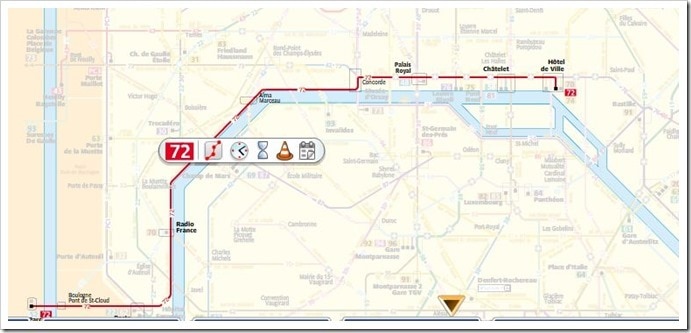
Although you can buy a Paris Visite pass that includes Zone 5 (so that you can commute into downtown Paris from either airport), you may want to opt for the shorter more direct bus via the Air France shuttle. This shuttle brings you to Port de Maillot at the northern part of the city, Charles De Gaulle/Etoile, Montparnasse or Gare de Lyon for either of the two airports in Paris. My personal favourite way to travel is Paris is on a bus… not a tour bus but actual public transport (RATP) and get around the city. When I lived in France, I did not drive. I took public transport wherever I went. I lived in the 16th arrondissement on avenue de Versailles but I went to school at the Sorbonne – University of Paris IV. Sometimes it would take longer to get home on the bus, but I enjoyed the commute more because you got to see one of the most beautiful cities in the world just outside your window. I would take the #72 bus from the Hotel de Ville to just past Maison de la Radio France. On the way you saw the Paris Hotel de Ville (city hall), Chatelet, Pont Alexandre III (the most ornate and beautiful bridge in Paris), travel down rue Rivoli and see the fancy shops, pass the Louvre, Les Tuileries, the Palais Royal, le Musee d’Orsay, Les Invalides, the Champs de Mars and of course the Eiffel Tower and Palais Trocadero. This is by far, one of the most scenic bus route.

The majority of the route is on the right bank of the Seine river. If you want a tour of the Latin Quarter on the Left Bank, take bus # 63. It commences at Gare de Lyon in the east and makes its way through the university area, past the Cluny Museum, the iconic corner of St. Michel and Saint-Germain-des-Prés (where you can hop off and go to Shakespeare & Co. bookstore) or continue on to Napoleon’s tomb at Les Invalides. The bus then crosses over the Seine to Place Trocadéro (across from the Eiffel Tower) and ends at Porte de Muette in the swanky 16th arrondissement.

Maybe you just want to ride the bus on one of the most beautiful boulevards in the world. You can take bus #73 which will take you from Musee d’Orsay around the Place de la Concorde up to the spectacular Champs Elysee to see the most prestigious French retailers in the world and then around L’Etoile (or the Arc de Triomphe). The route will continue to La Defence and the modern Grande Arche. If you get there you will see a linear line through all the important archways of Paris all the way to the small Arc de Triomphe du Carrousel in front of the Louvre.

If you wanted to see where Revolutionary History began, you would need to go to the Bastille. Also located there is the Opera Bastille the modern opera house of Paris. Begin your tour of the Right Bank here and take the bus #29 and head west. On this particular bus you will also see the oldest neighbourhoods of Paris. Get off at the Place Des Voges and visit Victor Hugo’s home where he wrote most of Les Miserables. You can also hop off at the Centre George Pompidou and visit the library, the museum of contemporary art or any number of chic thrift stores. As you progress you will see the stock exchange, the National Library, the original Opera and then make your way to les grand magasins or the hub of Parisian department stores (Les Printemps and Les Galeries Lafayette).


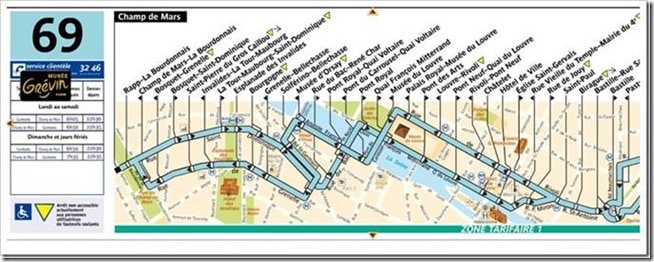
You could also take the route #69 from Bastille to the Champs de Mars at the base of the Eiffel Tower. This bus route would bring you down the famous rue Rivoli passing along the Louvre the Pont Royal, the Petite Carrousel, the Musee d’Orsay then heads west to Les Invalides and the Champs de Mars. So this route starts on the Right Bank and then crosses over to the Left bank.
Maybe you want to see Paris in all its glory. If you have the time you may want to take the Periferique Bus and Tramway route (PC1, PC3, 3A &3B). The Periferique is the ring road that goes all the way around Paris and crosses every gate or Port in the city. These ‘portes’ were the gates into the city. You would have to cross in (and pay a tariff to enter the city). There are officially four routes: North to South on the west side of the city (PC1), West to East (on the south side – Tramway 3A), Southeast to Northeast (Tramway 3B) and finally East to West on the north side(PC3). Take your pick: go clockwise or counter-clockwise. This is an interesting way to see the scope of the city.
No matter how many times I return to Paris, it is never long enough. I love many things about this city but one of the best is its bus routes.

🥾 Explore: Tours & Experiences
🏡 Where to Stay: Top Accommodations
🚙 Hit the Road: Car Rental Deals
🛫 Get Away: Find Flight Deals
🎒 Shop: Travel Essentials
My mom and I would LOVE to go to Paris! She doesn’t like buses, though, so I’m not sure if we would be able to do this, but I love the pictures!
Tiffany. I would suggest you take a bus tour if you don’t want to hop on and hop off a transit bus. There is so much to see in Paris that its best to try to get a lay of the land before sightseeing. It truly is a wonderful city.
What a great trip to Paris! I love all the pictures, it looks so pretty there. I’m going to take my daughter to Paris for her 16th birthday in a few years so I can’t wait to take this tour. Thanks for sharing!
Carin… she will love it! I went with my 19 year old and we had a wonderful trip. The thing is, make a plan because if you just go nilly-willy you will miss so much. Please come back to see other great Paris posts. There is one on the Modern Art museum at Centre George Pompidou that you might like on the blog.
I loved visiting Paris! This seems like an awesome tour company, I will definitely keep them in mind for my next trip!
Chantal: this is NOT a tour company but a tour of the city using public transport. It is for those that one to see the city without paying those crazy prices for a bus tour. And it is more authentic.
Wow, I would love to visit Paris! It’s definitely on my travel bucket list. You’re right that seeing a city from the buses is a great way to tour the city.
You MUST put it on your Bucket List. Everyone should see Paris once in their lifetime. I have to say, I would go back once a year if I could.
Wow! What beautiful photos. I’ve always wanted to visit paris myself and would love to take a tour like this, So amazing. I bet the sights are just amazing to see.
Jeanine, there is so much to see in Paris, it can be overwhelming. I went to Paris with my daughter for a few days after our trip to Barcelona so we were pretty tired but it was still wonderful.
I visited Paris years ago on a school trip…it is now more of a blur! I can’t wait to go back!
Its funny, I said to my daughter that graduates high school in two years that I did not want her to go on the school trip because it is too many cities in too little time. Cities like Paris should be savoured. Try to go back… you will love it.
I love Paris. I always want to go back. I went there when I was 7 months pregnant. A lot of walking for pregnant woman 😉
Seven month pregnant… wow… that would be a lot of walking. We spent the day in Versailles and when all was said and done, we walked 19 km (12 miles). Unbelievable for me. Do return and take it all in even if it is one a bus…
My uncle was born in Paris and I’ve always wanted to visit! Great post 🙂
Mar, you really need to go to Paris. It is an amazing place. But give yourself some time. There is a lot to see. Make sure to take a few of these bus routes for the real Parisian experience.
I want to visit Paris so badly! The pictures are beautiful and I would love to take the bus all over!
Lisa, I am so glad you would take my advice. Honestly, there is something about being on a public bus that makes the whole experience authentic. Main thing is, you can hop on and hop off at any time. The app is super helpful too if you just want to head back to your hotel at the end of your visit. Enjoy!
When my boys get older my hubby and I want to travel the world! Paris is number 3 on my list 🙂 Hopefully this bus tour is still around when I finally make it there!! 🙂
Savannah: I promise you the ‘bus tour’ is not going anywhere soon. It’s on public transit. I took some of these roots in 1981 and they still exist… Don’t wait until the kids are grown, go now with your hubby its super romantic!
Public transportation really is THE best way to see any city, and I can imagine just how amazing it is seeing Paris that way. What a great way to see the things that other visitors might miss!
Megan, the thing is that if you know which routes to take, you can easily get to where you want to go and see other ‘sights’ in the meantime. I love taking the bus. Thanks for dropping by. I have other posts on Paris if you are interested 🙂
Thanks for the amazing advice for visiting Paris! This is one trip that is near the top of my personal bucket list.
You must go Cassie… You will love it. It’s not hard to get to Paris from many US cities. It does not have to be along trip but plan for at least one week. The side trips to Versailles, Chartres or Fontaine Bleu are awesome too.
Paris is on my bucket list. One of these days this post and the bus tour schedule will come in handy.
Shell: I cannot say it enough. Going to Paris is something you should do once in your life. It is like going to New York City… You just have to experience it.
I remember taking the bus a few times when we visited Paris. It was a fun and convenient way to get around! We’d love to go back to Paris!
Jenn: I’m so glad you’ve been to Paris. Did you like it? The first time my daughter went she did not like it as much as when I took her. It was different for her as I had lived there for a year. So it was seeing it through my eyes…
I never knew the best way to navigate around that area! I hope to go one day, so I’ll definitely remember to catch the bus to navigate around.
Amanda, when you look at the stats, you realize the public bus system in Paris is huge! There are many ways to get from point A to point B… with so much to see in between. Thanks for dropping by.
Paris is such a beautiful city and I really hope to get there one day. The bus tour looks like so much fun!
Regan: I hope that you make it there one day. It has so much to offer: food, museums, parks, history… so much!
Oh, I’ll definitely have to check this bus tour out! I’m heading to Paris for the first time in April (for my birthday) and am spending eight days there. I really want to see as much of the city as I can <3