
This post includes affiliate links. When you purchase through these links, we may receive a small commission at no extra cost to you. For full details, please see our affiliate disclosure page.
June is National Indigenous History Month in Canada. My interest in Indigenous culture, history and tourism was piqued as listening to a webinar hosted by the Indigenous Tourism Association of Canada. It provided opportunities to participate in authentic Indigenous experiences for world travellers. If, however, you are unable to travel, a good book is another way to seek knowledge of other cultures. Having read Canadian Indigenous authors for many years, I recently finished the award-winning Seven Fallen Feathers by Tanya Talaga to start off my June National History Month book challenge.
This reading list presents an opportunity to learn about the unique cultures, traditions and experiences of First Nations, Inuit and Métis. This month is a time to honour the stories, achievements and resilience of Indigenous Peoples, who have lived on this land since time immemorial and whose presence continues to impact Canadians.
🏡 Where to Stay: Top Accommodations
🥾 Explore: Tours & Experiences
🚙 Hit the Road: Car Rental Deals
🛫 Get Away: Find Flight Deals
🎒 Shop: Travel Essentials
There are many wonderful storytellers who bring Indigenous tales to life. From the magical realism of Green Grass, Running Water, to the poignant (and heartbreaking), Five Little Indians and the riveting Marrow Thieves. Bookmark this page so you will come back to it or follow me on Good Reads to read my reviews on some of these books. All of the descriptions and images are from Goodreads – provided by the publishers.
Fiction
Green Grass, Running Water – Thomas King
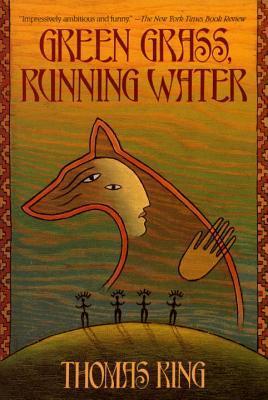
Strong, Sassy women and hard-luck hardheaded men, all searching for the middle ground between Native American tradition and the modern world, perform an elaborate dance of approach and avoidance in this magical, rollicking tale by Cherokee author Thomas King. Alberta is a university professor who would like to trade her two boyfriends for a baby but no husband; Lionel is forty and still sells televisions for a patronizing boss; Eli and his log cabin stand in the way of a profitable dam project. These three—and others—are coming to the Blackfoot reservation for the Sun Dance and there they will encounter four Indian elders and their companion, the trickster Coyote—and nothing in the small town of Blossom will be the same again…
There are so many other Thomas King novels to choose from but I would also recommend: The Back of the Turtle and Sufferance.
Five Little Indians – Michelle Good
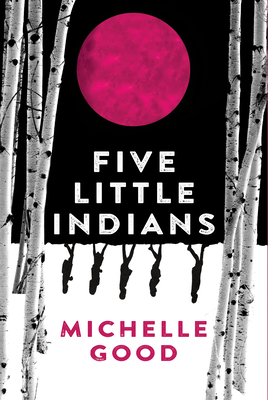
Taken from their families when they are very small and sent to a remote, church-run residential school, Kenny, Lucy, Clara, Howie and Maisie are barely out of childhood when they are finally released after years of detention.
Alone and without any skills, support or families, the teens find their way to the seedy and foreign world of Downtown Eastside Vancouver, where they cling together, striving to find a place of safety and belonging in a world that doesn’t want them. The paths of the five friends cross and crisscross over the decades as they struggle to overcome, or at least forget, the trauma they endured during their years at the Mission.
Fuelled by rage and furious with God, Clara finds her way into the dangerous, highly charged world of the American Indian Movement. Maisie internalizes her pain and continually places herself in dangerous situations. Famous for his daring escapes from the school, Kenny can’t stop running and moves restlessly from job to job—through fishing grounds, orchards and logging camps—trying to outrun his memories and his addiction. Lucy finds peace in motherhood and nurtures a secret compulsive disorder as she waits for Kenny to return to the life they once hoped to share together. After almost beating one of his tormentors to death, Howie serves time in prison, then tries once again to re-enter society and begin life anew.
With compassion and insight, Five Little Indians chronicle the desperate quest of these residential school survivors to come to terms with their past and, ultimately, find a way forward.
The Marrow Thieves – Cherie Dimaline
In a futuristic world ravaged by global warming, people have lost the ability to dream, and the dreamlessness has led to widespread madness. The only people still able to dream are North America’s Indigenous people, and it is their marrow that holds the cure for the rest of the world. But getting the marrow, and dreams, means death for the unwilling donors. Driven to flight, a fifteen-year-old and his companions struggle for survival, attempt to reunite with loved ones and take refuge from the “recruiters” who seek them out to bring them to the marrow-stealing “factories.”
You may want to also consider, Empire by Wild and Hunting by Stars.
Son of a Trickster – Eden Robinson
With striking originality and precision, Eden Robinson, the Giller-shortlisted author of the classic Monkey Beach and winner of the Writers Trust Engel/Findley Award, blends humour with heartbreak in this compelling coming-of-age novel. Everyday teen existence meets indigenous beliefs, crazy family dynamics, and cannibalistic river otter . . . The exciting first novel in her trickster trilogy.
Everyone knows a guy like Jared: the burnout kid in high school who sells weed cookies and has a scary mom who’s often wasted and wielding some kind of weapon. Jared does smoke and drink too much, and he does make the best cookies in town, and his mom is a mess, but he’s also a kid who has an immense capacity for compassion and an impulse to watch over people more than twice his age, and he can’t rely on anyone for consistent love and support, except for his flatulent pit bull, Baby Killer (he calls her Baby)–and now she’s dead.
Jared can’t count on his mom to stay sober and stick around to take care of him. He can’t rely on his dad to pay the bills and support his new wife and step-daughter. Jared is only sixteen but feels like he is the one who must stabilize his family’s life, even look out for his elderly neighbours. But he struggles to keep everything afloat…and sometimes he blacks out. And he puzzles over why his maternal grandmother has never liked him, why she says he’s the son of a trickster, that he isn’t human. Mind you, ravens speak to him–even when he’s not stoned.
You think you know Jared, but you don’t.
Birdie – Tracey Lindberg
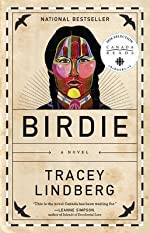
Monkey Beach meets Green Grass, Running Water meets The Beachcombers in this wise and funny novel by a debut Cree author.
Birdie is a darkly comic and moving first novel about the universal experience of recovering from wounds of the past, informed by the lore and knowledge of Cree traditions. Bernice Meetoos, a Cree woman, leaves her home in Northern Alberta following tragedy and travels to Gibsons, BC. She is on something of a vision quest, seeking to understand the messages from The Frugal Gourmet (one of the only television shows available on CBC North) that come to her in her dreams. She is also driven by the leftover teenaged desire to meet Pat Johns, who played Jesse on The Beachcombers, because he is, as she says, a working, healthy Indian man. Bernice heads for Molly’s Reach to find answers but they are not the ones she expected.
With the arrival in Gibsons of her Auntie Val and her cousin Skinny Freda, Bernice finds the strength to face the past and draw the lessons from her dreams that she was never fully taught in life. Part road trip, dream quest and travelogue, the novel touches on the universality of women’s experience, regardless of culture or race.
Firekeeper’s Daughter – Angeline Boulley
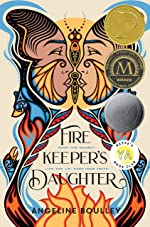
As a biracial, unenrolled tribal member and the product of a scandal, Daunis Fontaine has never quite fit in—both in her hometown and on the nearby Ojibwe reservation. When her family is struck by tragedy, Daunis puts her dreams on hold to care for her fragile mother. The only bright spot is meeting Jamie, the charming new recruit on her brother’s hockey team.
After Daunis witnesses a shocking murder that thrusts her into a criminal investigation, she agrees to go undercover. But the deceptions—and deaths—keep piling up and soon the threat strikes too close to home. How far will she go to protect her community if it means tearing apart the only world she’s ever known?
Bad Cree – Jessica Johns
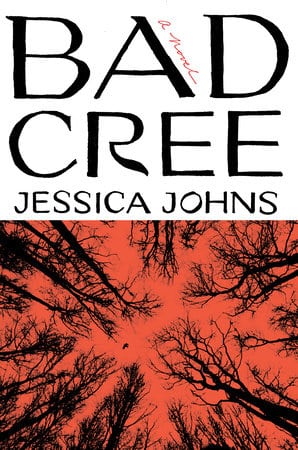
In this gripping debut tinged with supernatural horror, a young Cree woman’s dreams lead her on a perilous journey of self-discovery that ultimately forces her to confront the toll of a legacy of violence on her family, her community and the land they call home.
When Mackenzie wakes up with a severed crow’s head in her hands, she panics. Only moments earlier she had been fending off masses of birds in a snow-covered forest. In bed, when she blinks, the head disappears.
Night after night, Mackenzie’s dreams return her to a memory from before her sister Sabrina’s untimely death: a weekend at the family’s lakefront campsite, long obscured by a fog of guilt. But when the waking world starts closing in, too–a murder of crows stalks her every move around the city, she wakes up from a dream of drowning throwing up water, and gets threatening text messages from someone claiming to be Sabrina–Mackenzie knows this is more than she can handle alone.
Traveling north to her rural hometown in Alberta, she finds her family still steeped in the same grief that she ran away to Vancouver to escape. They welcome her back, but their shaky reunion only seems to intensify her dreams–and make them more dangerous.
What really happened that night at the lake, and what did it have to do with Sabrina’s death? Only a bad Cree would put their family at risk, but what if whatever has been calling Mackenzie home was already inside?
Split Tooth – Tanya Tagaq
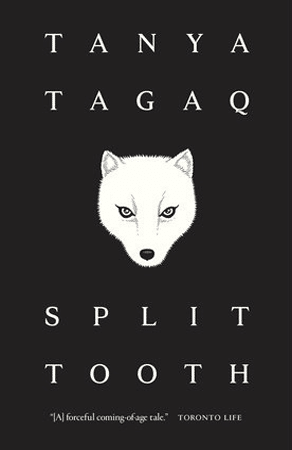
From the internationally acclaimed Inuit throat singer who has dazzled and enthralled the world with music, it had never heard before, a fierce, tender, heartbreaking story, unlike anything you’ve ever read.
Fact can be as strange as fiction. It can also be as dark, as violent, as rapturous. In the end, there may be no difference between them.
A girl grows up in Nunavut in the 1970s. She knows joy, and friendship, and parents’ love. She knows boredom, listlessness, and bullying. She knows the tedium of the everyday world, and the raw, amoral power of the ice and sky, the seductive energy of the animal world. She knows the ravages of alcohol, and violence at the hands of those she should be able to trust. She sees the spirits that surround her, and the immense power that dwarfs all of us.
When she becomes pregnant, she must navigate all this.
Veering back and forth between the grittiest features of a small arctic town, the electrifying proximity of the world of animals, and ravishing world of myth, Tanya Tagaq explores a world where the distinctions between good and evil, animal and human, victim and transgressor, real and imagined lose their meaning, but the guiding power of love remains.
Haunting, brooding, exhilarating, and tender all at once, Tagaq moves effortlessly between fiction and memoir, myth and reality, poetry and prose, and conjures a world and a heroine readers will never forget.
Non-fiction
Seven Fallen Feathers: Racism, Death, and Hard Truths in a Northern City

In 1966, twelve-year-old Chanie Wenjack froze to death on the railway tracks after running away from a residential school. An inquest was called and four recommendations were made to prevent another tragedy. None of those recommendations were applied.
More than a quarter of a century later, from 2000 to 2011, seven Indigenous high school students died in Thunder Bay, Ontario. The seven were hundreds of miles away from their families, forced to leave home and live in a foreign and unwelcoming city. Five were found dead in the rivers surrounding Lake Superior, below a sacred Indigenous site. Jordan Wabasse, a gentle boy and star hockey player, disappeared into the minus twenty degrees Celsius night. The body of celebrated artist Norval Morrisseau’s grandson, Kyle, was pulled from a river, as was Curran Strang’s. Robyn Harper died in her boarding-house hallway and Paul Panacheese inexplicably collapsed on his kitchen floor. Reggie Bushie’s death finally prompted an inquest, seven years after the discovery of Jethro Anderson, the first boy whose body was found in the water.
Using a sweeping narrative focusing on the lives of the students, award-winning investigative journalist Tanya Talaga delves into the history of this small northern city that has come to manifest Canada’s long struggle with human rights violations against Indigenous communities.
Last year, we decided instead of reading a book, we chose to listen to All Our Relations, Finding the Path Forward the 2018 CBC Massey Lectures by Tanya Talaga. I encourage you to learn more to listen to this moving lecture on Indigenous history and Indigenous culture.
Lecture 1 – We Were Always Here – Thunder Bay, Ontario
Lecture 2 – Big Brother’s Hunger – Halifax, Nova Scotia
Lecture 3 – The Third Space – Vancouver, British Columbia
Lecture 4 – I Breathe for Them – Saskatoon, Saskatchewan
Lecture 5 – We are Not Going Anywhere – Toronto, Ontario
21 Things You May Not Know About the Indian Act – Bob Joseph
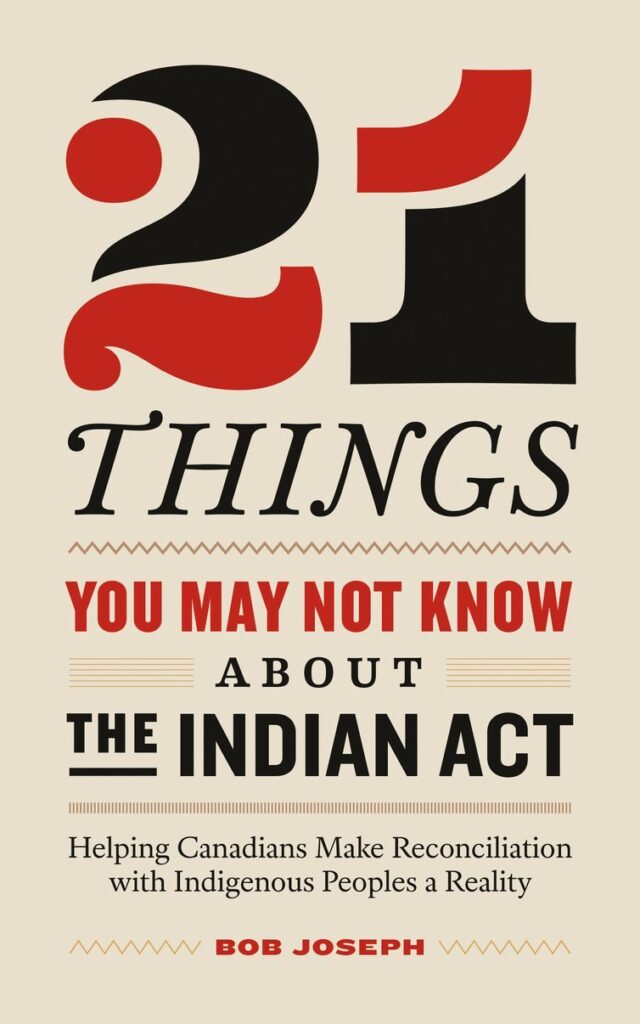
Based on a viral article, 21 Things You May Not Know About the Indian Act is the essential guide to understanding the legal document and its repercussion on generations of Indigenous Peoples, written by a leading cultural sensitivity trainer.
Since its creation in 1876, the Indian Act has shaped, controlled, and constrained the lives and opportunities of Indigenous Peoples, and is at the root of many enduring stereotypes. Bob Joseph’s book comes at a key time in the reconciliation process when awareness from both Indigenous and non-Indigenous communities is at a crescendo. Joseph explains how Indigenous Peoples can step out from under the Indian Act and return to self-government, self-determination, and self-reliance—and why doing so would result in a better country for every Canadian. He dissects the complex issues around truth and reconciliation and clearly demonstrates why learning about the Indian Act’s cruel, enduring legacy is essential for the country to move toward true reconciliation.
The Inconvenient Indian: A Curious Account of Native People in North America – Thomas King
The Inconvenient Indian is at once a “history” and the complete subversion of a history—in short, a critical and personal meditation that the remarkable Thomas King has conducted over the past 50 years about what it means to be “Indian” in North America.
Rich with dark and light, pain and magic, this book distills the insights gleaned from that meditation, weaving the curiously circular tale of the relationship between non-Natives and Natives in the centuries since the two first encountered each other. In the process, King refashions old stories about historical events and figures, takes a sideways look at film and pop culture, relates his own complex experiences with activism, and articulates a deep and revolutionary understanding of the cumulative effects of ever-shifting laws and treaties on Native peoples and lands.
This is a book both timeless and timely, burnished with anger but tempered by wit, and ultimately a hard-won offering of hope—a sometimes inconvenient, but nonetheless indispensable account for all of us, Indian and non-Indian alike, seeking to understand how we might tell a new story for the future.
Permanent Astonishment, A Memoir – Tomson Highway
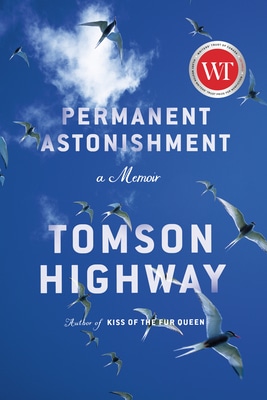
Capricious, big-hearted, joyful: an epic memoir from one of Canada’s most acclaimed Indigenous writers and performers
Tomson Highway was born in a snowbank on an island in the sub-Arctic, the eleventh of twelve children in a nomadic, caribou-hunting Cree family. Growing up in a land of ten thousand lakes and islands, Tomson relished being pulled by dogsled beneath a night sky alive with stars, sucking the juices from roasted muskrat tails, and singing country music songs with his impossibly beautiful older sister and her teenaged friends.
Surrounded by the love of his family and the vast, mesmerizing landscape they called home, his was in many ways an idyllic far-north childhood. But five of Tomson’s siblings died in childhood, and Balazee and Joe Highway, who loved their surviving children profoundly, wanted their two youngest sons, Tomson and Rene, to enjoy opportunities as big as the world. And so when Tomson was six, he was flown south by float plane to attend a residential school. A year later Rene joined him to begin the rest of their education. In 1990 Rene Highway, a world-renowned dancer, died of an AIDS-related illness. Permanent Astonishment: Growing Up in the Land of Snow and Sky is Tomson’s extravagant embrace of his younger brother’s final words: Don’t mourn me, be joyful. His memoir offers insights, both hilarious and profound, into the Cree experience of culture, conquest, and survival.
Final thoughts
The topics in these books deal with despair, social injustice, substance abuse, and suicide. They are also stories of resilience, civil rights activism, strong family ties, supportive communities and the love of history and traditions. Beautiful, rich inspiring traditions. All of these stories will make you question what you think you knew about Indigenous history, Indigenous culture, and Indigenous Tourism. You will be surprised by how much you will enjoy (and learn) from these books – as disturbing as some of the topics are. Without understanding Indigenous history we will never be able to advance as a human race.
Read more about Indigenous Travel, Culture & History
- Indigenous Tourism in Canada – Top 10 Authentic Cultural & Adventure Experiences
- Visit The National Gallery of Canada in Ottawa – Indigenous Art
- Indigenous Culture at The Grand Theatre – Rubaboo: A Métis Cabaret
🥾 Explore: Tours & Experiences
🏡 Where to Stay: Top Accommodations
🚙 Hit the Road: Car Rental Deals
🛫 Get Away: Find Flight Deals
🎒 Shop: Travel Essentials