This post includes affiliate links. When you purchase through these links, we may receive a small commission at no extra cost to you. For full details, please see our affiliate disclosure page.

What is Bell Let’s Talk?
Bell Let’s Talk is a multi-year charitable program dedicated to the promotion and support of mental health across Canada. Since 2010, Bell has committed more than $100 million to support a wide range of mental health organizations, large and small, from coast to coast focusing on anti-stigma, care and access, workplace mental health and research. To help you be part of the conversation, the Bell Let’s Talk Toolkit provides information and resources on how you can facilitate a conversation in your community, as well as guidelines on how to have conversations with people you care about and may be concerned about. The Bell Let’s Talk Toolkit consists of two elements: • facilitator’s guide and handouts to help you lead a group session • the Bell Let’s Talk conversation starters to help you have a one-on-one discussion with someone you care about. The goal is to help keep the conversation going all year long and make every day a day it is okay to talk about mental health.
🏡 Where to Stay: Top Accommodations
🥾 Explore: Tours & Experiences
🚙 Hit the Road: Car Rental Deals
🛫 Get Away: Find Flight Deals
🎒 Shop: Travel Essentials
This is a conversation about avoiding the stigma that can come from mental health issues. We are not always privy to all the fact or information of a particular case but at that does not mean that we can just ignore or pretend that a family member, friend or colleague is not dealing with some type of mental health problems. I have dealt with mental health issues in the past and I know what it is like to have a family member in crisis. I too have been in crisis at various times in my life and I knew that there was always someone there to help me. Just as I was there to help others. I have never shied away from the discussion on a personal level but yet it is not something that I hold on my sleeve either. Compromised mental health can do that to you. It can keep you silent, embarrassed and can make you doubt yourself because… “this never happens to anyone else”. But it does. More often than you think, to more people than you know. You would probably be surprised to know that following:
- over 2 in 3 people suffer in silence fearing judgment and rejection (Canadian Medical Association)
- 1 in 5 Canadians will experience a form of mental illness at some point in their life (Canadian Institute of Health Research)
- Only 49% of Canadians said they would socialize with a friend who has a serious mental illness. (Canadian Medical Association)
- 27% of Canadians are fearful of being around people who suffer from serious mental illness. (Canadian Medical Association)
- Mood and anxiety disorders impact an estimated 22% of the Canadian population. (CMHA)
- At this very moment, some 3 million Canadians are suffering from depression. (CMHA)
- Suicide accounts for 24% of all deaths among 15-24 year-olds and 16% among 25-44 year-olds. (CMHA)
- Two-thirds of homeless people using urban shelters suffer from some form of mental illness. (Canadian Alliance on Mental Illness and Mental Health)
- On any given week, more than 500,000 Canadians will not go to work because of mental illness. (Mental Health Commission of Canada)
- Adults with severe mental health problems and illnesses die up to 25 years earlier than adults in the general population. (Canadian Journal of Psychiatry)
- Less than 4% of medical research funding goes to mental illness research. (Canadian Alliance on Mental Illness and Mental Health)
- Once depression is recognized, help can make a difference for 80% of people who are affected, allowing them to get back to their regular activities. (CMHA)
- More than 30% of disability claims and 70% of disability costs are attributed to mental illness. (The Mental Health Commission of Canada)
- Approximately 11 people will end their lives by suicide today – and every day – in Canada (Canadian Association for Suicide Prevention)
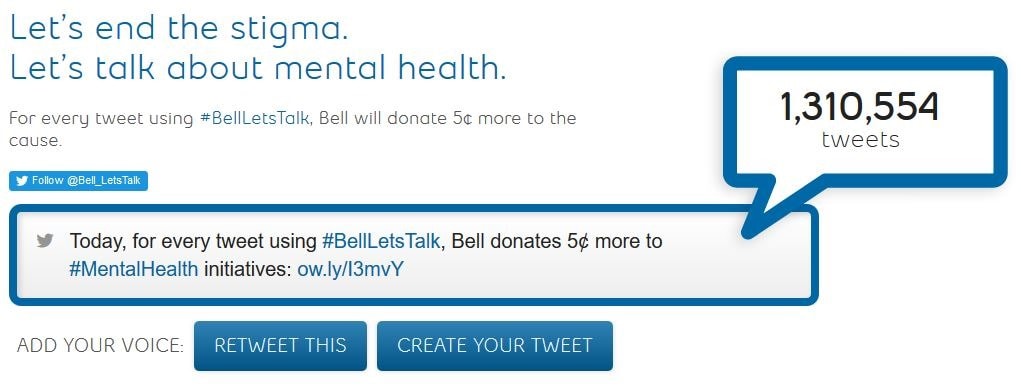
This morning when I took this screen shot at 10:53 am there were already more than 1.3 million tweets sent out to bring greater awareness off Mental Health issues in Canada. The #BellLetsTalk initiative is one that I have wholeheartedly supported for years now as I stand together with others to make sure that we take the stigma out of mental health.
5 Ways that you can Help:
- Language matters: Words can help…but they can also hurt. Pay attention to the words you use.
- Educate yourself: Learn the facts and myths about mental illness. Be knowledgeable and help fight stigma with facts.
- Be Kind: Small acts of kindness speak volumes.
- Listen and ask: Sometimes it’s best to just listen.
- Talk about it: Start a dialogue, not a debate.
I urge you to take the time to listen. Just listen when someone comments on their state of mind. You are not asked to be the saviour, the psychiatrist or the marriage counsellor, your are just asked to take the time to listen and see if you can help… or not. Maybe al that someone needs is someone to care enough to be kind.
Take the time today to post on your Facebook profile or page, tweet or text using the #BellLetsTalk hashtag so that your small gesture can help those that want to help and can help.
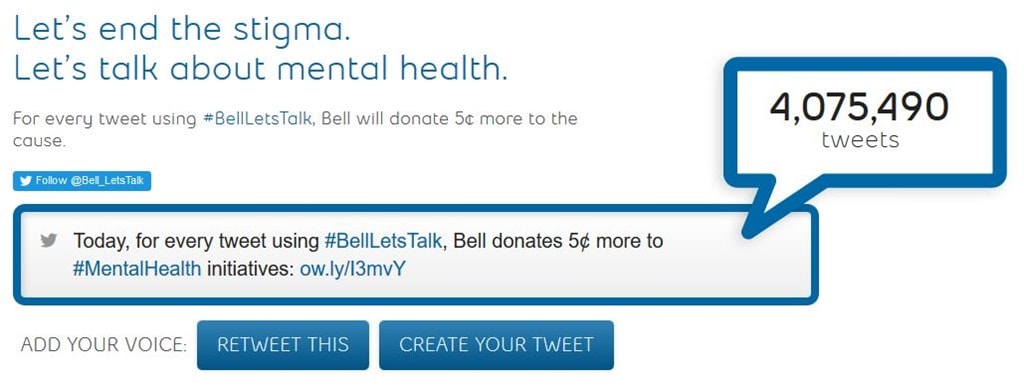
Here is the screen shot of the amount of tweets as of 5:50 pm today. At the end of the day, I will edit this post so that you can see how many acts of social media ‘kindness’ made a difference today.
This is by no means a sponsored post. This is an initiative that I believe in strongly and have supported. Please take the time to support too. All it takes is one small gesture!
🥾 Explore: Tours & Experiences
🏡 Where to Stay: Top Accommodations
🚙 Hit the Road: Car Rental Deals
🛫 Get Away: Find Flight Deals
🎒 Shop: Travel Essentials